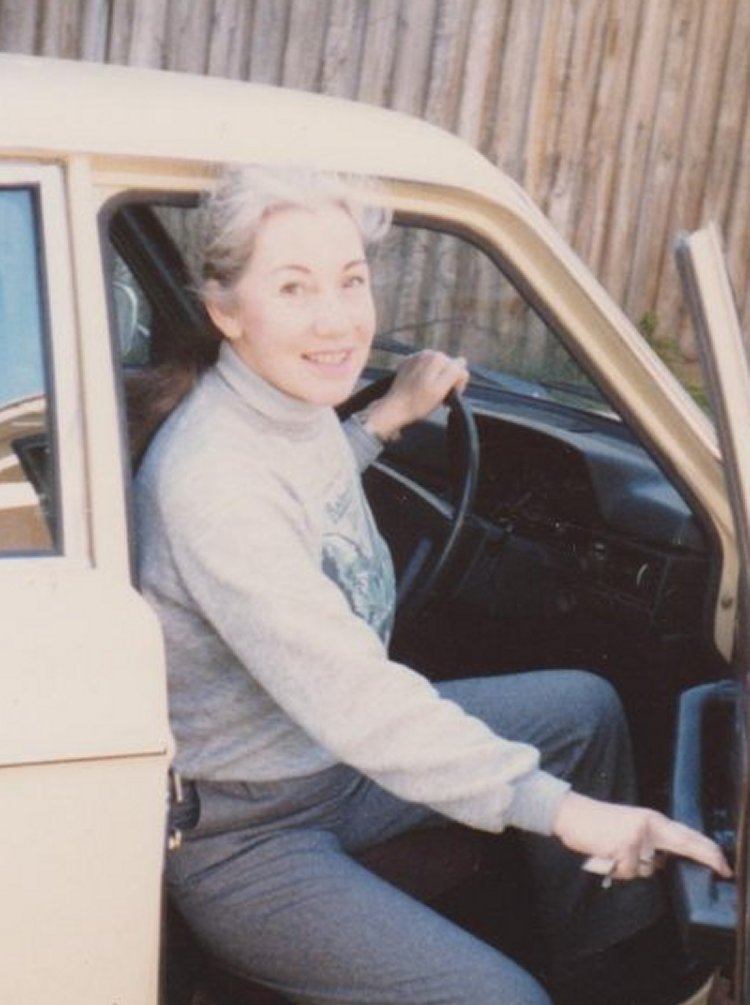
We have been off travelling again, this time to the USA.
Sunday, October 29, 2017
Wednesday, August 09, 2017
'Elderwoman' Republished at Last!
In 2015, when Findhorn Press told me they were taking my book Elderwoman out of print after thirteen years, I decided to republish it myself. It has taken me all this time to get around to doing it, but finally, here it is, the second edition, with an extra chapter that I added about how it felt to turn eighty last year.
And now, as well as a paperback with a brand new (and I think much nicer) cover and a cheaper price, there is also (at last!) a Kindle version.
Here is a link to it on Amazon.com And here is one to Amazon.co.uk.
My hope is that by now there will be a whole new generation of women crossing that midlife threshold who may find the book helpful. And if so, I hope some of them might even take time to go on Amazon and leave me a review.
Please help me spread the word!!
Monday, April 17, 2017
Elderwoman Newsletter - May 2017
The May 2017 issue of The Elderwoman Newsletter is now online at:
http://www.elderwoman.org/May17news.html
Sunday, October 02, 2016
Me - A Retrospective
Like most people, I save photographs. And like most people my age, a lot of those photographs pre-date the digital era. But of course paper deteriorates over time. Some folk who, like me, have collections of old photos in a box in the attic, are tackling the task of scanning them in order to preserve them for future generations.
Whether or not future generations will have the slightest interest in my collection I have no idea. And I certainly have neither the time nor energy to scan the hundreds of photos in that big old box. But I decided to nominate a few categories and pick out just a few pictures in each category to be scanned for posterity.
Here, then, is the first category. Me.
1943
1948
1955
1961
1969
1975 (approx)
1985
1994
2011
2013
It feels strange to think that the further back I go, the fewer people there are who remember those earlier versions of me. But looking back at them has been fun.
Saturday, September 24, 2016
Down from the Mountains
Whenever
we visit Italy - which we have been doing every year for the past six or seven
years - it is usually to the Mediterranean coast because I am such a lover of
the sea. But Sky also has a great love of mountains. So this year, as a special
treat for him, I organized a trip to the far north of Italy, to the Dolomites.
As
usual, we came overland - train from London to Paris, Paris to Zurich and then
down into Italy, watching with fascination as Alpine Switzerland gradually
morphed into Alpine Italy. I had often wondered what it would be like to live
in that border country. So we rented an apartment for a week in the beautiful
little town of Ortisei, nestled in a valley between majestic mountains, where
everybody lives in gorgeous, Tyrolean-style gingerbread houses bedecked with
flowers and you would swear you are on a set for The Sound of Music and yet
people are speaking Italian. However many also speak German and a lot of the
signage is in both German and Italian. This area once was a part of Austria
called South Tyrol but at some point in history it changed hands and became
part of Italy called Trentino-Alto Adige. It is fascinating to see this blend
of cultures.
Here is Garni Salegg, where we stayed:
This was the view from our balcony:
It would be hard to find
a more picturesque little town than Ortisei, nestling in a little green valley
called the Val Gardena. Here's a view down the main street with Sky in the
foreground:
And here is a view up
the street in the other direction:
Wood carving is the local cottage industry and there are interesting, innovative examples everywhere you look. (These carved figures have bee colonies living in their tummies!)
For the first couple of days we concentrated
on exploring the town and taking some walks in the valley. Then we bought
ourselves a three-day pass for all the lifts and cable cars, of which there is
quite a variety. We started off by taking a cable car up to Seceda, at seven
thousand feet...
...and hiking across the Alpine meadows...
...to an interesting rock formation called Pieralonga.
There, we had a picnic lunch beside a
mountain hut. What a glorious feeling, being on the roof of the world!
The following day, we rode the funicular to Resciesa, high up on the western side
of the Val Gardena.
There, we enjoyed a cup of coffee on the terrace as we gazed out at the
beautiful mountain scenery.
In the afternoon, we took a bus down to Selva at to the other
end of the valley and rode a cable car up on the eastern side to a spot called
Ciampinoi. The views from here were amazing.
On the third day, yet another cable car ride on the eastern side,
this time from Ortisei, took us up to six thousand feet and to the edge
of a glorious, undulating plateau called the Alpe de Suisi, dotted with trees
and criss-crossed by trails, some of which wound their way up into the far
mountains. There, we took two short hikes, one part way down into a shallow valley...
... and the other along the
edge, with magnificent views of the mountains.
After a wonderful week of 'ups and downs' in this delightful
little corner of the Alps, we spent a few days in Verona. The weather was hot and Verona was extremely crowded with tourists...
...especially around the area of 'Juliet's balcony' (so called).
However we enjoyed walking around the city and our little B&B on the bank of the River Adige was a delightful and very atmospheric place to stay.
After Verona, we headed south and east towards the Abruzzo, a rugged mountain region of Italy that we had never visited before. Here, we enjoyed a peaceful week in an apartment in the historic centre of Sulmona. This time there were no crowds, and almost no tourists at all and everything felt very laid back. Sulmona, with its narrow streets and ancient alleyways...
...and its beautifully preserved medieval aqueduct...
...is a most pleasant place to visit...
...and a great base for anyone planning to explore the Abruzzo's several national parks.
One of Sulmona's claims to fame (as well as being the birthplace of Ovid) is its'confetti' stores, of which there are at least a dozen along the main street. Whoever knew that so much could be done with one simple confection, i.e.sugared almonds?!
Yes, all the bright and flowery things you see in this picture are sugared almonds.
It was a great trip to the mountains, to Verona and to Sulmona. And now it's over.
After a four-day train journey via Milan, Geneva, Paris and London, we are home again.
(And already planning our next adventure.)
Saturday, May 28, 2016
At This Time of Year...
.
...in our Devon hedgerows,
the campions reign supreme.
And when I get to the top of this lane, there is another beautiful sight to behold.
Nature is so forgiving, so resilient. Will it always be able to bounce back, just as these orchids do? As climate change bites ever more deeply and the sixth great mass extinction picks up speed, what will survive? Who will survive? In a hundred years, a thousand years, will the orchids still pop up each year? Will the campions still reign supreme in the month of May? How many more years will the hawthorn tree outside the bathroom window of our cottage blossom in glory, like it is doing right now and probably has done every year since the cottage was built in 1733?
Who knows? But right now, in this moment, in the midst of all this beauty, and despite the dark despair that so often tries to overwhelm me, I feel blessed.
Living in these times can feel schizoid. But as Charles Eisenstein said in a recent essay,
"I am fond of saying that no optimism can be authentic that has not visited the depths of despair. But today I have realized a corollary: no despair is authentic that has not fully let in the joy."
I think he is right. So much so that when I look at these orchids and I start to cry, I realize that it is neither joy nor grief that makes the tears flow.
It is both.
...in our Devon hedgerows,
the campions reign supreme.
And when I get to the top of this lane, there is another beautiful sight to behold.
The wild orchids have popped up again...
...like they do every year around this time,
despite the rough treatment this ground has seen during the winter, with those big, clumsy agricultural machines that gouge out deep, muddy ruts and hack the hedges around.Nature is so forgiving, so resilient. Will it always be able to bounce back, just as these orchids do? As climate change bites ever more deeply and the sixth great mass extinction picks up speed, what will survive? Who will survive? In a hundred years, a thousand years, will the orchids still pop up each year? Will the campions still reign supreme in the month of May? How many more years will the hawthorn tree outside the bathroom window of our cottage blossom in glory, like it is doing right now and probably has done every year since the cottage was built in 1733?
Who knows? But right now, in this moment, in the midst of all this beauty, and despite the dark despair that so often tries to overwhelm me, I feel blessed.
Living in these times can feel schizoid. But as Charles Eisenstein said in a recent essay,
"I am fond of saying that no optimism can be authentic that has not visited the depths of despair. But today I have realized a corollary: no despair is authentic that has not fully let in the joy."
I think he is right. So much so that when I look at these orchids and I start to cry, I realize that it is neither joy nor grief that makes the tears flow.
It is both.
Wednesday, April 20, 2016
Deep Green Living
The ebook is available through both Smashwords (in all the popular ebook formats) and Amazon, and it costs less than a cup of coffee.
The reason that we at GreenSpirit sell our ebooks for next to nothing is that we are not the least bit interested in making money from them. The only reason we produce them is that we want to introduce our message (about loving the Earth and caring for it) to as many people as we possibly can.
(In fact, we would be perfectly happy to give them away for free. The only reason we don't is that many people like to use the Kindle to read their ebooks and to publish a book on Kindle means you are obliged to set a price.)
I am hoping that some of our readers will take the time to post a review on Amazon or elsewhere. Even just a few sentences and a good rating will make me a very happy bunny indeed. And I know the contributors will be delighted that their work is being read and reviewed.
Click here to read a list of contents, find out more about the book and its contributors and click through to it on Smashwords and Amazon.
Labels:
books,
eco-awareness,
GreenSpirit,
simplicity,
webstuff
Sunday, May 17, 2015
Roller-Coasters and Robins
Most of us who have been parents will probably recall that our children's behaviour seemed to cycle between periods when everything seemed calm, pleasant and easy and periods when chaos reigned and we started to wonder what we were doing wrong. I remember very well the day, nearly half a century ago, when I discovered a book in our local library that explained how and why this process occurs.
"Research by the Gesell Institute of Human
Development has shown that this pattern of behavior is very common and that
children’s growth is not always steady and progressing from less to more
maturity. Instead, their development follows a course in which smooth, calm
behavior often precedes unsettled, uneven behavior. It is almost as if children
need to take two steps backwards developmentally before taking a huge leap
forward.
In fact, all children grow through predictable stages of
development beginning at birth and extending far into their teen years. Some
experts in the field refer to this occurrence as going through periods of equilibrium
versus disequilibrium. Children cycle in and out of times when they are more a
joy to be with, It cycles up and down and in and out of times when their
behavior can be more or less challenging – (disequilibrium). Hence, the “roller
coaster” of child development.
The equilibrium periods can be looked at as a time when your
child is consolidating learned skills; practicing what he has struggled to
master; they are plateaus in development. The disequilibrium periods often
occur as the child is entering a new, quick time of growth and development,
when he is mastering new tasks and working on new abilities."
It was a huge relief
to me to discover that this roller-coaster of psychosocial development
throughout childhood is perfectly normal and not some sign that I was somehow
being a bad parent.
I hadn't thought
about that in years. Until yesterday, when I suddenly found myself wondering
whether the increasing disequilibrium we see and sense all around us as our
materialist, consumerist Western culture starts to come apart at the seams is
in fact part of a similar pattern.
Do humans, collectively, go through a similar set of stages to those we see in individuals? I suspect that maybe we do. There are certainly many 'experts' around today who say that we are now in a new phase of evolution. But we know from history and biology and paleontology that new evolutionary projects don't always proceed smoothly or easily—or even successfully.
If we are indeed "entering
a new, quick time of growth and development, when we are mastering new tasks
and working on new abilities" it will be because we have no other choice.
Overpopulation, the ruthless exploitation of Nature and a
doomed-to-be-short-lived reliance on non-renewable fossil fuels has brought us
to the point where we MUST learn new skills and learn them very quickly if our
species is going to survive at all.
Shall we succeed?
Nobody knows. I feel sad, sometimes, that I shall almost certainly not live
long enough to greet—and enjoy—the next stage of equilibrium. For that will
surely be a time of peace and sustainability, when humans have at last learned
how to live in an ecocentric way, like true Earthlings, knowing themselves to
be a part of Nature and interdependent with all other life forms. If indeed
such a stage is ever reached.
If it is not, well
perhaps it is as well for me that I shall die unknowing and still hoping. That way, on my deathbed, if
I hear the robin singing in the tree outside my window I can die still believing
that there is a chance. I can die thinking that maybe—at least for the next few
billion years till our sun becomes a supernova—there will be robins, and trees for them to sit in, and a song for them
to sing.
Thursday, October 30, 2014
Off Travelling Again
Yes, I have been neglecting this blog for several months. And that, of course, is because we have been 'on the road' once more.
Here's my latest trip report - once again from Italy.
http://www.elderwoman.org/Italy_Sept-Oct2014.html
Here's my latest trip report - once again from Italy.
http://www.elderwoman.org/Italy_Sept-Oct2014.html
Sunday, September 14, 2014
Harvest Then and Now and ...Again?
It is September and the green fields around here are
interspersed with gold, just as they have been for generations. Not that there
is much arable farming in this area as the culm grassland is mostly sheep and
cattle country. But our local farmers do grow a little wheat and barley and
this has been a wonderful year for it as the weather has been so warm and dry.
Over recent weeks, on my daily walks around the countryside, I've had to keep a
lookout for clanking, looming, lumbering farm machines pulled by tractors whose
wheels, in some of the narrower lanes, reach from hedge to hedge.
The other day, two passed me in quick succession. The first
was an ordinary, small baler—the sort that turns out neat little rectangular
cubes of straw. The sight of it took me right back to the summer I turned 11,
when we lived on a farm and my friend Edwin and I rode on an empty cart to the
wheat field where the sheaves were piled in stooks. Talking and teasing and
chewing on wheat grains, we watched the farm workers with their pitchforks,
deftly slinging the sheaves on to the cart until it was full. And then we rode
back clinging on to the back of the cart, with straw ticking our noses. The
first big machine in the farmyard
processed the wheat, pouring a river of seed into a sack. The remaining straw
went, all free and unruly, into the other machine and came out the other end as a disciplined
bale, all neat and rectangular, tightly compressed and bound with wire. The
bales got piled up in a big, cubist-style stack and until the process was
finished the stack was multi-levelled, so it was fun to climb to the top and
jump from level to level (until they shooed us away).
Unlike the straw, hay was rarely baled back then. It just got
tossed by pitchfork on to an ordinary, free-standing stack in the corner of the
field—the traditional haystack that you'd have trouble finding a needle in. I
didn't even notice the gradual disappearance of haystacks in the countryside
until one day I realized that they were all gone.
The second machine that passed me in the lane the other day
was a different one—sleeker, and more modern-looking. I had no idea what its
function was until I caught up with it ten minutes later in a field and watched
in fascination as it churned its way through some hay, with its rear section slowly revolving, and then
stopped to poop out one of those huge, round bales that you see everywhere
these days, neatly bound in plastic.
And that just about describes the evolutionary path of the
harvest during my lifetime. From men with sun-browned arms slinging hay and wheat sheaves
with pitchforks in 1947 to modern machines creating giant, plastic-coated
parcels too heavy to heft except with a machine. In my grandmother's day and maybe into my mother's lifetime
also they would have used shire horses instead of tractors. The tractors of my
childhood were small, noisy, smelly things with bouncy metal drivers' seats. No
doubt the tractor seats of today still bounce but the drivers sit high up,
aloof, in air-conditioned comfort, shielded from the weather and deaf to
birdsong, talking on their phones.
What I am wondering now, is whether I shall live long enough
to see it all come full circle. When this unsustainable, head-in-the-sand culture
that has been overreaching itself for so long finally has to face up to the devastating
effects of its failure to honour the Earth's natural limits shall I still be
here to bear witness ? When the oil is so scarce that the tractors can't run
and things are falling apart and the process that blogger/author John Michael Greer calls 'The
Long Descent' leaves us no alternative but to roll our sleeves up and harness
up the shire horses (if we can find any to harness, that is), shall I still be around to watch the guys who used to
build up their muscles at the gym do it with pitchforks instead? Probably not.
Though if I manage to live to a hundred and the changes happen fast, well, you
never know…
Picture © Andrew Smith
Tuesday, August 26, 2014
Summer Ending (in haiku)
Nights are lengthening.
Leaves hang heavy, all that's left
one fluttering fall.
Swallows gathering:
"Mum, why must we wait on wires?
—and what's 'africa?'
"
Shall I burrow down
here into my home soil, or
follow the sun south?
Subscribe to:
Posts (Atom)