Wednesday, November 06, 2013

Exploring Islands


I have been absent from this blog for a lot of weeks now and that is because I have been indulging my passion for travel, especially in the Mediterranean region and especially in Italy. 
This autumn, Sky and I returned to both  Sardinia and Sicily and explored five small offshore islands that we have never visited before. Here is my account of our travels: 

Friday, August 30, 2013

Engaged Elderhood

One day recently, two things that came into my email inbox at the same time set me thinking about the way old age is commonly portrayed in our culture these days. The first was a post by that indomitable blogger, Ronni Bennett, whose 'Time Goes By' blog about aging is read and relished by hundreds of people every day. In this post, headed 'An Old Age Better Than I Ever Expected,' Ronni wrote: "I never expected to feel as alive and vibrant and spirited and vital as I do at this time of my life." She was remarking about something that many of us have often said and felt but probably don't proclaim loudly and publicly and frequently enough, i.e. the discovery that elderhood has the potential to be one of the most enjoyable and satisfying of all life's stages.

Why should we expect it to be otherwise? Well, as Ronni goes on to say: "There is little if anything in our culture that would lead me to believe I would feel this good about being an old woman. The media relate to old age almost entirely via health, poor health - and mostly about dementia."

And she's right. The awful image so commonly presented by the media seems to be that once you finally give up the (obviously futile) effort to 'stay forever young', all that is left is just a slow countdown to death. Old age is portrayed as a time of sharp physical and mental decline, withdrawal from the world, misery, illness, incontinence, loneliness, incapacity, feebleness and dementia.

Which brings me to the second item in my mailbox. It was a helpful suggestion that since I edit a newsletter for elderwomen and have a website about women and aging I might like to add some links to useful, elder-related websites about...yes, you guessed it: illness, medication, incontinence, incapacity, dementia...

What the writer seemed not to have noticed was that my books, websites, newsletters—and sometimes this blog—are all focused on the hundred and one far more important aspects of this section of our life journey: our attitudes, our feelings and experiences, the role of elders in the community, the culture and the world, our personal and spiritual growth...and so on. Not on indigestion remedies.

Yes, for sure if we can no longer walk upstairs we may need to install a stair lift, but if so we simply Google 'stair lifts,' read some reviews and do some comparison shopping, just like we do for every other major purchase. We may want to find out more about prescription drug side-effects but the Internet is full of info about those (and also full of good advice about how to live healthily and drug free at any age). Why on Earth should I want to fill up my links page with info about the relative merits of various brands of incontinence pads just because my readers are all over fifty?

As William Thomas says in his brilliant book What Are Old People For? getting old does often necessitate a search for work-arounds that enable us to keep functioning optimally—in fact he sees elders as walking advertisements for the wonderful human capacity for endless adaptability. This ongoing process of adaptation to each change in the ever-changing body doesn't begin at 44 with the first pair of reading glasses however. It begins in toddlerhood, with shoes to protect our tender feet, bibs to catch the drool, high chairs to keep us from falling on to the floor and pull-up pants for toilet training. It continues through orthodontic appliances, tampons and nursing bras, dental crowns and hiking poles and all the way through to Zimmer frames. Humans are clever animals and we have become really good at finding ways to augment our bodies' functions and deal with their impairments and inconveniences. But these logistics of our lives are not what defines them. It is meaning that defines them. It is meaning that gets us up in the morning and meaning that makes our hearts sing.

Rather than being preoccupied with what we are losing, the key to an old age full of meaning is to look at what we are gaining and also at what we are giving. As Jung taught us, the second half of life is about individuation, about growing fully into our potential selves. And it is about sharing with the world the fruits of our personal harvest. Elders, rather than withdrawing from the world outside their skins are at their happiest and most fulfilled when they are engaged with that world. I call this 'engaged elderhood.' Our beleaguered planet, right now, needs all the engaged elders it can get.

So if there is anyone out there who dreads getting old and really does believe that old age is nothing but dyspepsia, aching joints and damp knickers, let me assure you that it doesn't have to be like that at all. Honestly. And if you don't believe me, read Elderwoman. Or, if you are male, pre-order this great new book by my friend Alan Heeks called Out of the Woods: A Guide to Life for Men Over 50. Alan's book is due for publication on September 19 and can be pre-ordered now from the author's website in the UK or from Amazon in the US.


Tuesday, July 16, 2013

Making a Mark


My Teva sandals have a distinctive tread on their soles and when the summer sun softens the tar patches along the lane the little kid in me can't resist pressing my foot's pattern into them. Then, next day, I look to see if my footprints are still discernible. They almost never are of course. By the time the sun has left the lane and the tar has cooled, they have long since been obliterated by tyre tracks.

Yesterday, though, I found one. The boots of those few others who had passed that way had missed it and, since it was near the centre of the lane, so had the vehicles. I felt strangely pleased.

I detest graffiti. Yet in a way I understand the impulse to leave a mark. So would I step in wet cement? No I wouldn't, out of consideration for others and because I would feel terribly guilty afterwards, just as I did when I was thirteen and carved my name on a beech tree. But I would think about it. I would imagine doing it. The temptation would be there to make a mark and then come back later to look at it as it set into that which, in this world, passes for permanence.

What is it about us humans that makes us so keen to leave our mark? Is it the ego's denial of mortality that urges us to create something that will outlive us even though we know that whatever it is will, like the statue of Ozymandias, eventually follow us along the path to oblivion? Nothing is eternal. Permanence is an illusion. Everything changes in every instant. The quantum universe is nothing but a vast, restless dance of energy and we and all our works blink in and out of existence like fireflies in the dark of unimaginable space.

I know that. I know that in another decade or two (or less probably) I shall be gone. Oh I shall live on a bit longer in the memories of those who knew me, particularly those who loved me. The books I have published will remain in print a few years maybe, and some of my traces in cyberspace might even persist till after I am dust. But as that which constitutes this separate me dissolves back into the All-That-Is, it will soon become just a faint outline, like yesterday's tar footprint, and eventually it will be as gone as a cup of seawater tipped back into the ocean.

Since some of my books were written with a helpful purpose, I hope they will remain a while. But apart from that, does any of this really bother me? Well, not so much, any more. I think I am learning at last the futility of trying to make a permanent home out of today's evanescent reality. And here is where I think I differ from the kid with the spray can who scribbles his tag on the wall and scuttles away. Because for me, as well as the tactile pleasure of a sandal pressed into soft tar, it is not so much about longing for permanence as it is about coming back and looking again. It is about wondering what will be different tomorrow. It is about noticing and being fascinated by— and yes honouring—the inevitable process of constant change and unpredictability that lies at the quantum core of everything. Even if the looking makes me sad.

Here's a sonnet I wrote thirteen years ago that seems to fit well...


I am so old that I remember green
grass hillsides where now mushroom villas crowd;
blue, endless space, and rising skylark seen
dark silhouetted, singing to a cloud.

Behind neat privet hedge, hydrangeas bloom.
Video library. Fast food for sale.
Car parks and garages. No longer  room
here for the spinney, or its nightingale.

Yet the old beech still stands, and in her bark,
carved long ago by thoughtless, teenaged hand,
my name, scar-tissued to the faintest mark,
may just be traced. At last I understand

forgiveness. Fifty uncomplaining years
the tree has waited for these healing tears.


'The Mark' © Marian Van Eyk McCain, 2000


Wednesday, June 05, 2013

A Summertime Flowering


This year, as the unusually late spring nudged up against the first days of summer, we have seen an amazing array of wildflowers along our lanes and hedgerows. The bluebells, which are usually long gone by this time of year, lingered long enough to co-exist for several weeks with the first pink flushes of campions...
...and even now, in a few shady places, there are still a few primroses to be found, and even celandines.
Mind you, at this time of year, the campions and the buttercups reign supreme.

There is stitchwort everywhere I look, and the white theme will become ever more dominant over the coming weeks as the various wild carrot species start to take over the scene completely. Meanwhile, in certain places the wild orchids are appearing. And soon, now, there will be meadowsweet all along the verges and the fragrance of honeysuckle will fill the air. 

Our hawthorn tree is blossoming and so are the apple trees. Bees are buzzing and swallows are swooping.
And as I walked around taking all these pictures yesterday, I couldn't help thinking...
How sweet and wonderful it is to be alive at this glorious time of year!


Tuesday, May 14, 2013

Getting From Here to There


We have just been doing some travel planning and that set me thinking, once again, about my relationship to modern modes of travel.

One of my early heroes was Ivan Illich, who died in 2002 at 76 (the age I am now). I was lucky enough to meet and converse with him at one point in my life and it is to him that I owe many of my ideas about simple and sustainable lifestyles.
Illich, as he was when I met him
Illich was famous for pointing out that in many areas of human so-called 'progress' there comes an optimum moment in time beyond which the trajectory reverses and whatever-it-is, instead of assisting us, starts at best to lose its potential for improving our lives and worst to cause us harm, either as individuals or as a species.

This turning point has often come much earlier than we thought (and is almost always unnoticed). For example, as Illich pointed out in his 1970s essay, “Energy and Equity,” so much human energy is used up in the production and ownership of cars that they can be shown to be far less energy-efficient than bicycles. Bicycles, he said, were the really great breakthrough. All increases in speed beyond that have ended up actually being counter-productive—not to mention being damaging to the planet's ecosystems.

Man, unaided by any tools, gets around quite efficiently, and is more thermodynamically efficient than any machine and most animals." said Illich. "Man on a bicycle can go three to four times faster than a pedestrian, but uses five times less energy in the process. The bicycle is the perfect transducer to match man’s metabolic energy to the impedance of locomotion. Equipped with this tool, man outstrips the efficiency of not only all machines but all other animals, as well.”

When I lived in town I used to ride my bicycle a lot. I rode it to work and back (on the days when I didn't walk) and I used it for all my shopping trips. The only reason that I don't use it now is that these days I live in a very hilly place and have to spend so much time pushing my bike uphill that it is easier and more comfortable simply to walk.

But whether walking or cycling, travelling at slow speeds keeps us in contact with the world around us in a way that car travel never can. Cars encapsulate us in little, fast-moving bubbles that somehow seem to create a barrier between our bodies and the environment through which we are moving. Of course, buses and trains, too, whisk us around at far beyond bicycle speed, but for some reason that I haven't yet quite worked out I always feel much more comfortable on a bus or a train than I do in a car. Maybe it is because I can move around more inside the vehicle—especially on a train—and because the space feels larger, airier and less claustrophobic.

Planes, whilst more spacious than buses, are a hundred times more claustrophobic—especially in the Economy section. Air travel catapults us from place to place and across time zones in a way that creates havoc in our body's energy systems, turns our vision of the Earth's surface into distant wallpaper, subjects us to all kinds of discomfort, indignities and airborne viruses (not to mention the awful food) and totally confuses our natural, animal sense of distance.

This is why, even though it takes us three days (and three buses, four trains and a ferry) to get to our favourite vacation place and costs probably four times as much as flying, I would still rather go there slowly.

(I only wish I had the energy and stamina to ride my bike from here to there instead. That way I would really see the countryside. But of course I'd still have to take the ferry across the watery bits)

Sunday, February 24, 2013

Spiritual Teachers

Watkins magazine just published its annual list of the 100 most spiritually influential people in the world. It was interesting to see whose names made it on to that list, but I found it even more interesting to ponder about all those whose names didn't - and why they didn't.

How, I wondered, would you go about compiling a list like that? It seems they did it mostly by looking at how many times people entered those names into a search engine, but of course to enter the name of a spiritual teacher into Google you first have to know their name. It occurs to me, however, that at least 50% of the spiritual teachers in my own life have been people whose names nobody has ever Googled. Like the Scottish gardener for instance. Let me tell you about him.
Many years ago, when the daily walk from my home to my workplace used to take me through a small park, I often stopped to exchange morning greetings with the gardener who looked after the park. He was a short, bronze-skinned Scotsman with a happy smile and a jaunty air. And at least twice a week, as our morning paths crossed and we chatted briefly about this or that, he would make some seemingly simple comment that for some reason would echo in my mind for hours afterwards, a comment which, on later reflection, I realized was actually quite profound. It was no wonder, I sometimes mused, that this little park is such a pleasant spot; no wonder that the flowers shine so brightly and the grass is such a vibrant green, for this gardener, in his unassuming way, is encouraging them to grow, just as his words encourage growth in me.

It is experiences like this that have helped me gradually come to realize, over the years, that everyone I meet is my teacher and that every situation holds within it the opportunity to learn and grow. Yet as we go about our ordinary, everyday life,  this constant, two-way process of teaching and learning is for the most part something that happens below the level of our ordinary consciousness.

Then of course there must be a whole lot of spiritual teachers who do get Googled but presumably not enough to get themselves on to the Watkins list. Although I have been taught and influenced by many of those who names do appear on the list, the one whose influence on me has been the greatest of all is one whose name doesn't. Not yet, anyway. So let me introduce you...

Tuesday, January 22, 2013

A Different Sort of Fresco


We spotted this bit of décor last month in a Fresc Co cafeteria in Barcelona (a welcome oasis for a pair of veggies like us in a country where, according to a travel guide I read, "The Spanish think the pig is a vegetable").

What a wonderful idea, posting the nutritional value of the food right up there on the wall – and in a pretty way, too! Well, with a name like 'Fresc Co' it is hardly surprising, I suppose. But I'm glad they thought of it.

Now how about posting, on the walls of certain other types of eateries, some info about the true health effects of trans-fat-full, GM corn-laden, over-salted, over-sugared fast food? 

Tuesday, October 16, 2012

As Plain As the Nose On Your Face

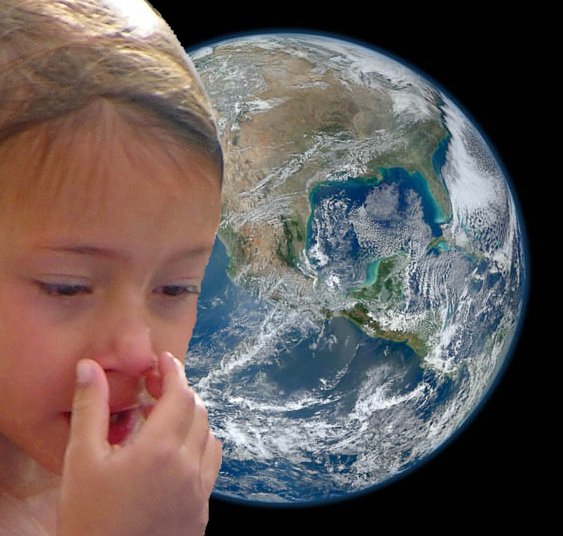
I wouldn't have the courage to leap out of a capsule 23 miles up, that's for sure. Hell, I could never even pluck up courage to leap off the high diving board. But one thing I do envy our culture's latest daredevil hero for and that's the chance to see the Earth from that incredible height, to get a greater sense of its curvature, its wholeness, its planet-ness. And to feel in his body, for four whole minutes and at a greater intensity than ever before, that deep strong pull homewards that we know as gravity.

One of the first astronauts to see our Earth from space spoke fervently about his feeling of identification with it. Just as we may see a photo of our own house, our own street, our own town and say "Ah, there's home," he suddenly realized that he was seeing, through the porthole of his spacecraft, the only home that humans have ever known. And exhilarating though that moment was—he said later that it changed his whole life—one can only imagine the profound sense of relief he and his companions felt when their feet eventually touched solid ground again.

Most of us never get further up than 40,000 feet and even then we are more likely to be watching movies, reading in-flight magazines or waiting for the drinks trolley to reach us than we are to be marvelling at our (somewhat) expanded view of the landscape. And millions of our fellow humans have never been inside a plane. However, the concept of flight, the concept of travel, even on a train or in a car, plays tricks with our minds. In fact, just our very ability to move from place to place on foot rather than being rooted in one spot for life, like a tree, gives us a false idea of who and what we are.

We talk about being on the Earth, as though anyone except Neil Armstrong has ever actually been on anything else. Religious people sometimes talk about being 'stewards' of the Earth, as though our planet hadn't managed perfectly well for millions of years before we turned up, a few cosmic seconds ago, to be its self-appointed 'stewards.' We talk about 'Mother Earth' and ourselves as her children, but most children grow up and leave home and that is one thing we cannot do. Nor would we want to.

We have no difficulty in seeing rocks and mountains, sand and sea, rivers and stones as being an intrinsic part of the fabric of our planet. Even plants, we can imagine as part of that fabric, since apart from tumbleweeds they mostly stay where they are. But moving creatures, the ones with feet and hooves and wings and manufactured wheels, those seem different to our literal, childlike minds and it takes a leap of intellect—a leap that many people seem unwilling or unable to take—to understand, to really get it, that we, too, are just as much a part of the Earth as a mountain, a pebble or a mushroom. The molecules and atoms we are made of have been here since the Big Bang and the energy forces that formed those molecules and atoms were here even before that, part of a vast mysterious universe that is beyond the grasp of our finite minds. 

Yes, it is an intellectual leap, but it is a leap worth making because it is a leap that can change your life. Some people can go even further than that and are able, even if only for a few seconds at a time, actually to experience that oneness and have a total knowing and bodily feeling of it that is way beyond all thought or concept. I long for the day when we can all do that. 

I want to say to everyone: you are part of this planet in the same way that your nose is part of your face. Yes, theoretically you could chop your nose off and hurl it out into space, beyond the sky, beyond gravity's pull…


But why would you ever want to?

Monday, October 08, 2012

September in Sardinia


Here we are, home again after a marvellous
month spent exploring Sardinia.

It was our first trip there but I think - and hope - that it will be the first of many. 
What a beautiful island and what warm and wonderful people we met, everywhere we went.

I just finished creating a report of the whole trip,
with lots of pictures. 
You will find it at:


Tuesday, July 31, 2012

Self-Therapy Made Easy

Today, instead of my usual musings, I am going to do some shameless self-promotion. It's something authors do, I'm afraid. In fact these days our publishers not only expect it, they require it.

Why today? Because here comes another new book! This is another in the 'Made Easy' series from John Hunt Publishing. The 'Made Easy' books span several of the publisher's different imprints, so while  the last one I wrote, Downshifting Made Easy, was under the Earth Books imprint, this new one is under an imprint called Psyche Books.

Readers of my book The Lilypad List, may remember that there was an appendix in the back of that book with some ideas about self-therapy and quite a few readers said they found this useful. Those ideas are greatly expanded upon in this new book. I hope people will find this one useful also.

Here is a post from me on the Psyche Books blog that explains what the book is all about and why I wrote it.

Tuesday, June 26, 2012

The 'Right' Path of Relationship

Last Tuesday Margaret Wheeler Johnson, an angel-faced young journalist from New Orleans, now based in New York City and editing the ‘women’ section* of the Huffington Post (*they call their sections ‘verticals’ but I can’t yet bring myself to accept ‘vertical’ as a noun) published an interesting piece on relationships.

Following the lazy writer’s fashion for quirkily numbered lists masquerading as articles, hers was entitled ‘31Ways To Know You're In The Right Relationship.’
And I, being a lifelong sucker for quizzes, went through the list. Not that I needed a checklist to know I am in the right relationship. I knew that already. But 31 criteria? Goodness me!! I diligently checked them off, all of them, happily confirming what I already knew. 


I aced the test. And ended up wondering how Margaret devised it. Did she figure it out, based on her own experience of good relationships (even though she looks too young to have had much of that) or did she do lots of research, talk to marriage counsellors etc…or what?

At first I found myself wondering if there were any other criteria that I, as a psychologist with many years experience in couple counselling, might have added to her list. But then I decided that for me the ‘right’ relationship isn’t based on lists at all. The right relationship is the one you are in now. At a spiritual level, every relationship is the ‘right’ one because we are each other’s teachers and our most intimate partners are the greatest teachers of all. It is from them that we learn most about who we are; it is through them that we grow. The learning and the growing might sometimes be painful. All relationships are destined to change over time, simply because we change over time. Sometimes that change may involve conflict, estrangement, separation and/or divorce and always, somewhere along the time line, it will involve death. But no relationship ever actually ends: it merely changes form. The first man I married eventually became my ex-husband and then he became my deceased ex-husband but at some level our souls are still connected and always will be. It was never the ‘wrong’ relationship even though it ended in divorce.

 For that young journalist, being in the ‘right’ relationship probably means that you and your partner get along so well that you have a good chance of remaining partners till death doth you part. Her 31 criteria are perceptive and accurate. Combined, they could be seen not only as a good prescription for ‘success’ in relationship but also as a good diagnostic tool for anyone experiencing problems in this area. Topics, if you like, in a curriculum designed to teach us how to behave with our significant others—something most of us learn through trial and error. Because relationship is not about success vs. failure or rightness vs. wrongness. It’s about learning. There are no mistakes. Only outcomes. Only lessons. When we embrace this we are ready to enter into a conscious relationship, i.e. one in which in which both parties understand their relationship as a path of spiritual growth

I have one of my former teachers, John Welwood, to thank for this awareness. His teachings on conscious relationship have been my inspiration and my guide. As he says in his beautiful and seminal essay ‘Intimate Relationshipas Transformative Path’, “If relationships are to flourish, they need to reflect and promote who we really are, beyond any limited image of ourselves concocted by family, society, or our own minds. They need to be based on the whole of who we are, rather than on any single form, function, or feeling. This presents a tremendous challenge, for it means undertaking a journey in search of our deepest nature. Our connection with someone we love can in fact be one of the best vehicles for that journey. When we approach it in this way, intimacy becomes a path— an unfolding process of personal and spiritual development.”   Yes, oh yes. 

Monday, March 26, 2012

Sunshiny Days

How very hard it is to stay indoors when the sap is rising, the birds are singing and the garden is calling me to dig and weed, and rake and sow. Who wants to sit at a desk, staring at a screen when they can sit or walk or work outside and feel sunshine on their skin? Well, some folks might, but I don't.

My skin craves sunshine. I know this is not just because I spent forty years of my adult life living in sunny parts of the world like Australia and California and got accustomed to it, because I remember how I craved sunshine as a child. It was as though there was some ancient piece of programming in this English brain of mine that made it well-nigh impossible to remain indoors on a sunny day. Whenever I awoke to a morning of blue sky and slanting sunbeams I would experience an immediate and powerful urge to leap out of bed and run outdoors. 

I can still remember, vividly, the power of that bodily urge and I remember how quickly and surprisingly it left me when I moved away from England. So much so that I forgot all about it for decades until, the first spring after I came back here to live, it reasserted itself with the same force as ever. 

There was an item in the BBC news yesterday about the importance of Vitamin D to our health and about how we poor denizens of the northern latitudes who don’t get enough sunshine on our skin need to take Vitamin D supplements to keep ourselves healthy. Those same health authorities who fussed and worried and sent us all scurrying for shade and slathering ourselves from head to toe with SPF 15, are now suggesting that maybe they went a bit too far overboard and a little sun on the skin is actually a Good Thing  (just a little, mind). Not that I ever took much notice of those warnings in the first place, except that I was always careful not to burn. 

My own experience tells me that sun-craving, for people who live as far north as I do, is actually an adaptive mechanism. I am convinced that, just as the food cravings of pregnancy signal a shortage of some dietary element or another,  sun-craving is a natural and evolutionary response to insufficient levels of Vitamin D. So, as with everything else, if we remain fully tuned to our bodies and fully receptive to their messages and requests—which, by the way, tell us not only when to get out into the sun but also when it is time to move to the shade—they will serve us faithfully and with much gratitude.


Tuesday, February 28, 2012

Productivity Rules (Forever, dammit!)


When I look back and muse upon it—which I frequently do each evening as I draw the curtains—the very best kind of day is one that has contained all the following ingredients:

● I created something

● I exercised my body

● I spent time outdoors

● I completed something

● I enjoyed myself

● I felt fit, healthy and in love with life 

Some days are like that. But how to deal with the ones that are not? How to deal with the days when I feel like Stephen Leacock’s character who “… flung himself from the room, flung himself upon his horse and rode madly off in all directions.”?
How to deal with the days when, as I draw the curtains, I cannot even remember one single thing I actually did except for eating meals, going to the bathroom and checking email?

How to deal with days when, despite all my good intentions, the piles of paper keep piling up and all efforts to bring order to my chaos fail (again)?
How to feel OK about a whole day spent sitting in an armchair reading the latest Michael Connelly murder mystery when I really should be out there doing Something To Save the Planet (or at least pulling a few weeds in the veggie garden)?

Over  the years I have convinced myself that it is perfectly OK to be erratic, perfectly OK to have quiet days and doing nothing days, perfectly OK to please myself from moment to moment as regards what I do with my day, especially now that I am retired and officially an old woman. Besides which, I’m a writer and writers need quiet gestation time as well as busy scribbling time, right? Yes, I have convinced myself of all these excellent arguments. And yet…

Something I have noticed is that it is heaps easier to feel good about a doing nothing day if it happens to occur on a Sunday. Interesting, isn’t it? Interesting to notice how deeply our childhood conditioning  sinks into our psyches, how it is reinforced throughout our lives by twelve or more years of schooling and half a century's exposure to the industrial culture* and how hard it is to eradicate entirely. Kind of like couch grass.

Anyone else noticed this?

(* not everyone is paid for what they do, more's the pity, but we're all conditioned by the so-called 'working week.')
 

Monday, January 30, 2012

All Our Relations


Have you noticed how so many of the ways that we talk about Nature and about our fellow creatures drive a semantic wedge between ‘it’ and us, between ‘them’ and us? So much so, in fact, that it is quite a challenge to talk about other life forms without falling into the trap of separating ourselves from them with our words.

There is absolutely no doubt whatsoever that our species Homo sapiens is a member of the Kingdom called Animalia (we are animals), the Phylum Chordata (we have spines), the Subphylum: Vertebrata (a special sort of spines), the Class: Mammalia (we suckle our young), the Order: Primates (along with apes, and monkeys), the Family: Hominidae (one of the so-called ‘great apes’) and the Genus: Homo (men and women, boys and girls). Yet to listen to the way we speak about ourselves—and the way we think about ourselves—you would never know it.

After all these centuries of imagining ourselves as separate from the rest of the animal kingdom and forgetting that all of these other life forms are our relations, our language has been shaped by our beliefs. So yes, it is hard to avoid the linguistic traps. But I really wish we could all try harder. It really bothers me when I hear people say “humans and animals,” as though we weren’t animals. We need to reverse the trend and re-shape our language to fit our new realization of who we really are—one organism among the billions that make up the body of the living Earth.

It bothers me when I hear phrases like “walking in Nature,” as though there were any place on our planet were Nature isn’t. Nature is us. Nature is in us and everywhere and in everything. Even in the heart of the city, Nature is not just the pigeons and rats and cockroaches and mice and the slivers of living green that grow up in the cracks between the paving stones, but all-pervasive. The air is full of unseen creatures; our own bodies have other creatures living on and within them, creatures in their millions. We are Nature and Nature is us.

For all of my adult life I have consciously and delightedly revelled in the experience of being woman, being human, being animal. So when Stephanie Sorrell, one of my fellow authors at John Hunt Publishing, told me she was thinking of co-ordinating a new publishing imprint called ‘Animal’ I was delighted. If any of my readers are interested in Stephanie’s proposal, you will find it here.


So if you have a book in you and it is about other animals and our relationships with them, contact Stephanie. The email address, in case you can't read it very well in the box,  is animalpub(at)hotmail.com (just replace (at) with the @ sign)

Tuesday, December 13, 2011

My Solstice Message

Like most other children, I loved Christmas. I loved the mystery and magic of it, the scent of pine needles, the gifts, the food, the carols and of course the story. And like most other parents, I wanted my children to have the same experience. But in between my own childhood Christmases and my children’s childhood Christmases there was a very big gap: a gap of fifteen years and half a planet.

Oh I did all the same things that my mother had done and my grandmother had done: dressing the tree, hanging the decorations, wrapping the gifts, stuffing the turkey…and I made sure that the magic of Christmas was there for my children, just as it had been for me. It was—or so they tell me. However, it was not the same magic. Because by the time I had children I had relocated from one side of the globe to the other. So my children’s experience of Christmastime was not just the tree and the gifts and the rich food, it was also sunshine, blue skies and long, lazy days on the beach or at the local swimming pool.

It took me a long time to work out exactly why, as the years went by, I found myself disliking Christmas and wishing it did not have to happen. It was only when a friend of mine—an expert on symbolism—pointed out to me that almost all the traditional rituals we had taken with us from Europe to the Antipodes derived from ancient ways of celebrating the winter solstice— the promise of light returning to a dark, winter Earth—that my reaction suddenly made sense. Out there, in the blazing sunshine on the longest day of the year, why would I want to be lighting candles, stringing tinsel, hanging up stars, bringing in an evergreen tree…all those symbolic ways of honouring a midwinter moment?

Every year, I would hear various Australian friends talking about the irony of sending each other cards covered in snow and holly and eating rich, winter food when even the sparrows and mynah birds were wilting in the midsummer heat. “Let’s do it differently next year” they used to say, and everyone would nod and agree. Yet the old ways persisted. It seemed to me that there remained a deep disconnect between the migrants from Europe and the land in which they now moved. I felt it myself. The traditions and rituals we had grown up with didn’t work there but we all seemed incapable of devising new ones appropriate to the place and the season. To do so would require the kind of deep rootedness in the land from which rituals emerge organically, but the roots of many Europeans in Australia are still in the pots they arrived in. It may take centuries for the transplants to be complete.

By the time I came back to live in the Northern Hemisphere—and eventually, in retirement, to my native land—the over-advertised, stressful, jangly consumerfest that Christmas had become had no meaning or interest for me whatsoever. It now felt like something to avoid. At first, I felt like some kind of Scrooge, half guilty for not sharing what for others was still a joy. But as time went on that feeling dropped away, leaving me free to enjoy my own reality and seek my own sources of delight.

Nowadays, my partner and I quietly celebrate the winter solstice in our own small but meaningful ways—a meditative walk in the wintry woods, a glass of wine, a special, simple vegetarian meal at which we give thanks for the miracle of life within and around us, our deep and joyful belongingness to Earth and our faith that the days will once again lengthen and the sun will eventually return, as it does every year, to bathe and warm us with its rays.

What a joy it is to be free to choose. To be free of what the Russian writer Vadim Zeland—author of the much-acclaimed Reality Transurfing series of books—calls a ‘pendulum,’ a force field of communal energy that draws people into its embrace and traps them there. Over the years, dozens of people have told me they dislike Christmas…even dread it. Yet for one reason or another, they remain caught in the energy pendulum that Christmas has become.

This is one of the glorious freedoms we have discovered in our old age: the freedom, finally, to walk away from energy pendulums and do things in ways that are meaningful to us, regardless of what the rest of the world does. We don’t judge anyone else for their choices. For those who love to buy presents, send cards, hang baubles on a tree, pull crackers and eat some kind of bird, Christmas remains the magical experience it always was. And that’s great. For those who derive a special meaning and joy from the tale of a baby born in a stable, it is a special and holy time. Likewise for those who honour the traditions of their ancestors through Chanukah or Kwanzaa. For us, what is special and wonderful is that we no longer feel obliged to join in any of it. And we are fortunate in that, as far as we know, nobody judges us for that choice.

So my wish for you, as 2011 draws to a close and a new year begins, is that you will be happy in your choices and take delight in your freedom to choose.

(PS: Here's a great article on a similar topic, with lots of helpful and practical advice)

Thursday, November 10, 2011

More Murmurations

I remember blogging about this last year - or maybe it was the year before. But it happens every year and every year it gives me a thrill to see the winter starlings arrive again in their thousands and dance in the sky. I love to feel the rustling currents of them around me as they swoop low over the hedgerows or take off from the stubble fields with a roar of wings.
Of course, it signals a few months of heavy traffic around the bird feeders, as these brash migrants from northern Europe muscle their way in amongst the more timorous locals. But when they put on aerial ballets like this one so beautifully captured on video by Sophie Windsor Clive (to whom many thanks),I cannot begrudge them even one seed.
Murmuration from Sophie Windsor Clive on Vimeo.

Monday, August 29, 2011

Future Primitive - an interview

Whenever someone asks me a question about how I see the world or what it is that I care about, my mind blossoms with a million answers. Shaping my response to fit the requirement of the moment is always a difficult task for me.

It is so much easier when I can give the answer in writing, for that gives me time to think, to choose, to employ the exact sequence of words and sentences that will best express my truth. But every now and then I am required to speak ‘off the cuff.’ And this was one such time. In this 47-minute interview with Joanna Harcourt-Smith, which took place a few days ago, I had an opportunity to talk about some of the subjects closest to my heart, especially conscious aging, simple living, green spirituality and the role of the elderwoman.

It was a great privilege to take part in Joanna’s project and I would encourage you to check out the Future Primitive website and download some of the other podcasts she has produced.

Meanwhile, here is mine, complete with all its ‘ums’ and hesitations and hastily-chosen words that the perfectionist writer in me would love to improve upon.

(The bio was taken from my website and is not entirely up to date, as I am no longer secretary of the WFA – my apologies to Tess for that oversight.)


Friday, July 22, 2011

Eradicating Ecocide

Wonderful news!
Polly Higgins's landmark book Eradicating Ecocide has won the People's Book Prize, 2011. Congratulations, Polly!
http://www.eradicatingecocide.com/general/eradicating-ecocide-peoples-book-prize/
And now, the whole world needs to read the book...

...and the whole world needs to come to its senses and recognize ecocide - the destruction of Earth's precious ecosystems - as the utterly heinous crime it truly is.

Monday, July 04, 2011

Shoulder High to a Thistle


This morning’s walk takes me through my favourite meadow. It is my favourite because it is one of the few fields around here that really is a meadow in the traditional sense, i.e. several unploughed, undisturbed acres of mixed grasses and wildflowers rather than one of those the ryegrass monocultures so beloved of present day agribusiness.

Right now, as we move into July, the meadow is a wild natural profusion, an effusive, flowering, seeding, jumble of colour, shape, size and texture. Except for the well-trodden footpath that runs through its centre, most of the grasses and flowers that live here are waist-high now.

I stand next to a tall, many-branched thistle plant that is at least a foot taller than I am. Looking around, I can see a dozen more such lofty specimens, each bristling with flowers, some already beginning to go to seed. Could that be why they aspire to such a height, to take advantage of the breeze when the time comes to waft their progeny aloft on thistledown wings? It can’t be just to catch the light that they grow so tall, surely, since the entire meadow is in full sun. But maybe, I think to myself, there is no basis for their decision to keep reaching for the sky except the sheer exuberance of the creative, universal life force that powers them. And I feel the tingling flow of that same energy in my own body as I stand there in the meadow in the morning sunshine, shoulder high to a thistle.

Which, when you think about it, is the sort of relationship in which we ought to see ourselves at all times, we puny humans, compared to the vast plant kingdom on which our very existence depends. In fact, if height were a measure of ultimate importance in the scheme of things, perhaps ankle high would be more accurate. Even that might be to exaggerate our own significance.

If we have any importance, any special role to play in all of this, I think it is, as Brian Swimme suggests in his chapter of GreenSpirit: Path to a New Consciousness, our ability to be amazed. Perhaps my role, right in this moment is merely to stand next to this thistle plant that towers over me and reflect on the wonder, joy and beauty of that and of this beautiful sunny morning in the meadow.

Wednesday, May 25, 2011

Downshifting? Easy Does It!

I am delighted to announce that my new book on downshifting,
Downshifting Made Easy: How to plan for your planet-friendly future is now available for purchase.
It is one of the first six books in the new ‘Made Easy’ series that my publisher, O Books, is launching at 6:00 p.m. on Wednesday June 1st at Watkins Bookstore near Leicester Square in London.
Click here to find out more about the launch. It’s a free event, of course, so if any of my blog readers happen to be around I would love to meet you there.
The aim of the O Books ‘Made Easy’ series is to condense into small, inexpensive and easy-to-read books as much useful information as possible on a wide range of interesting topics.
The aim of Downshifting Made Easy, like that of my book The Lilypad List and so much of my other writing, is to inspire people to live more lightly and joyfully on this beautiful Earth.
In particular, I want to convince my readers of three key things that I have learned from my own experience and from that of many ‘downshifters’ I have met. These are:

- You don’t have to move house in order to downshift to a greener lifestyle

- Downshifting is an inward, spiritual process as well as an outward, practical one

- Once you start downshifting, your life gets steadily more satisfying and more joyful


Please break some (virtual) bubbly against the bows of this little book as it sails down the publishing slipway. And please share this post widely.
Thank you.